Tools / Flagsmith
Flagsmith
Open-source feature flags and remote config for web, mobile, and server apps
About Flagsmith
Manage feature flags across environments, target users with segments, run A/B tests, and change app behavior remotely without redeploying code.
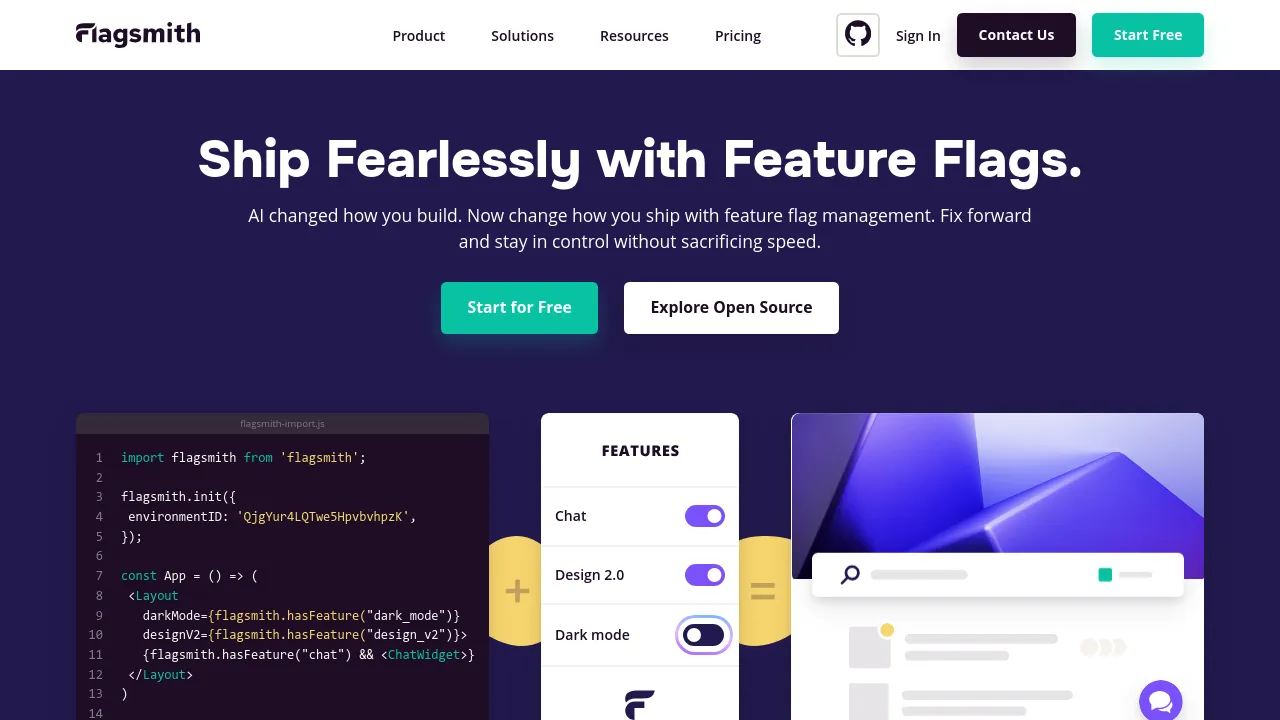
Flagsmith is an open-source feature flag and remote config service. You wrap parts of your codebase with flags, then turn features on or off, target them at specific users, or change their values from the Flagsmith dashboard — without a new deployment. The same flag can behave differently per development environment, per user, per segment, or for a percentage of traffic, which covers practices like canary releases and staged rollouts.
Every flag in Flagsmith doubles as remote config. Beyond a simple on/off toggle, you can attach values — a checkout payment option, a button color, a feature parameter — and update them in real time. For mobile apps this means you can change behavior without waiting for app store approval. Flags can also be split across two or more variations for A/B/n testing, and flag data can be sent to your existing analytics platform.
Integration is via SDKs and a REST API. The homepage shows a JavaScript example where flagsmith.init() is called with an environment ID and features are checked with flagsmith.hasFeature(), and a curl example hitting https://api.flagsmith.com/api/v1/flags/ with an environment key. Client SDKs are listed for a range of popular languages and frameworks, including Ruby. The homepage displays logos of companies including Okta, Citi, Ford, Vontobel, Wistia, and Creditas.
Best for
- Teams that want to decouple feature releases from code deployments
- Mobile developers who need to change app behavior without app store review cycles
- Teams running A/B or multivariate tests with percentage-based flag splits
- Organizations that want to self-host an open-source flagging solution instead of building one in-house
- Teams practicing canary deployments or gradual rollouts by segment or percentage
- Product teams managing flags across web, mobile, and server-side applications from one place
Frequently asked questions
Is Flagsmith open source?
Yes. The site markets itself as an open-source feature flag service, so you can review the source and self-host it.
What languages and platforms does Flagsmith support?
The site says it supports popular languages and frameworks and lists client SDKs in its documentation, with Ruby and a REST API shown on the homepage. Check the docs for the full, current list.
Can Flagsmith do more than on/off toggles?
Yes. All flags support remote config values, so you can change feature parameters — like payment options or UI colors — without pushing code. Flags also support multivariate splits for A/B/n testing.
How does targeting work?
You can configure features per development environment, for individual users, for segments defined by user traits or behaviors, or for a percentage of users.
How much does Flagsmith cost?
The homepage doesn't show pricing. Check the Flagsmith website for current plans, or self-host the open-source version.
Can I send flag data to my analytics tools?
Yes. The site states you can integrate with your existing stack and send flag data to your analytics platform.
Alternatives

Similar to Flagsmith
New tools, once a week.
One weekly email with curated tools and founder insights. Unsubscribe anytime. Check our privacy policy.