Tools / Redis
About Redis
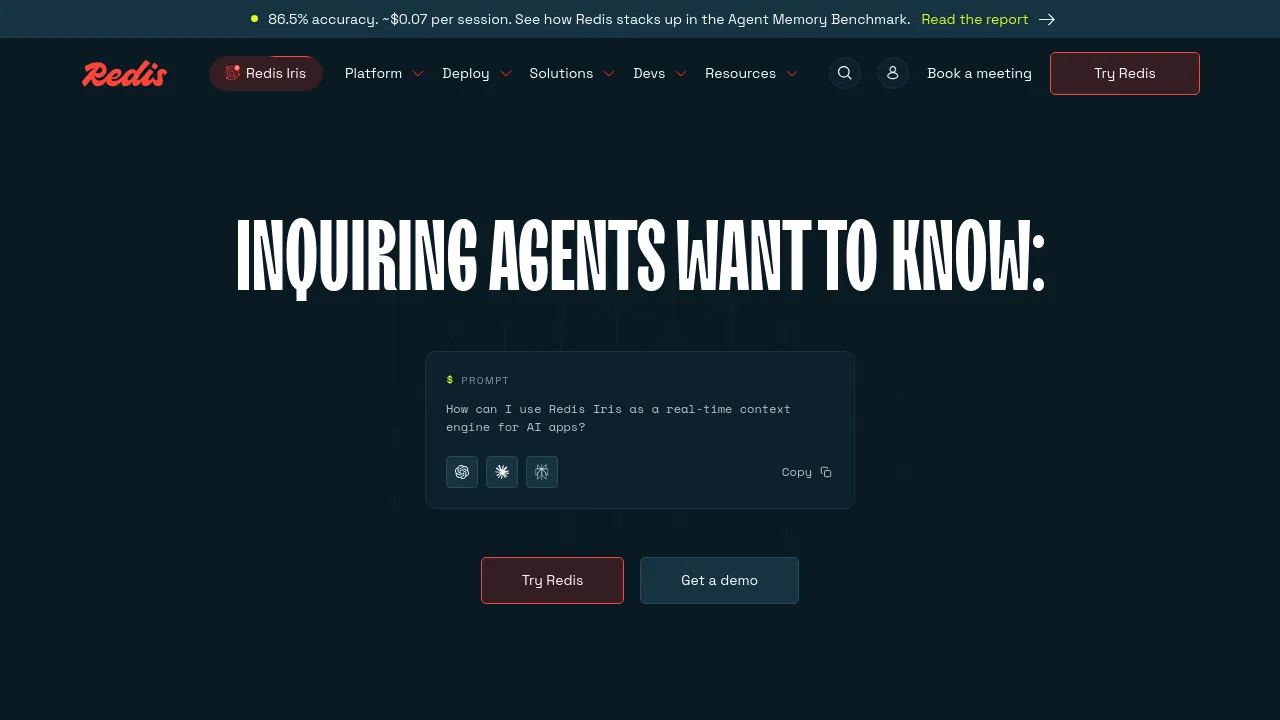
Redis is an in-memory data store used for caching, streaming and messaging, session management, and search. Data lives in memory, which is why it's commonly placed in front of slower databases to serve reads and writes with sub-millisecond latency. Beyond the core key-value store, Redis now covers a set of adjacent workloads: vector search and semantic query for RAG and AI apps, agent memory (the site cites 86.5% accuracy at roughly $0.07 per session in its own Agent Memory Benchmark), LangCache for caching LLM responses to cut token spend, a feature store for real-time ML, leaderboards, and CDC-based data integration. It also handles classic queue and pub/sub messaging via streams. Deployment options span Redis Cloud (managed), Redis Software (on-prem), Redis Open Source (currently Redis 8.8), and managed offerings through AWS, Azure Managed Redis, and Google Cloud Marketplace. Tooling includes Redis Insight (a GUI for visualizing and debugging data), RIOT for data ingestion, and official client libraries for Python, Node, Java, Go, .NET, and others. Documented use cases include fraud detection, real-time decisioning, and session storage, with industry pages for financial services, retail, gaming, healthcare, and telco. The homepage names customers like Ulta (40% increase in revenue through a Redis-powered online experience), Superlinked (100+ vector search queries per second), Sony LIV (37% faster API responses with a 15% lower memory footprint), and Plivo (over a billion API requests per month).
What Redis does
Redis keeps data in memory so reads and writes happen in sub-millisecond time. That makes it a fit for workloads where a disk-based database is too slow: caching, session storage, rate limiting, leaderboards, and real-time messaging.
Main capabilities
- Caching — sub-millisecond reads and writes at scale
- Streaming and messaging — event-driven pipelines and pub/sub
- Session management — persistent, fast session storage
- Search — query and search over structured data, including vector search for semantic applications
- Agent memory and AI tooling — Redis Agent Memory, LangCache (caches responses to common questions to reduce token spend), and Context Retriever
- Feature store — real-time ML feature pipelines
- Data Integration — CDC across structured data
- Redis Flex — extends capacity beyond RAM for larger datasets at lower cost
Deployment options
- Redis Cloud — fully managed
- Redis Software — self-managed, on-premises
- Redis Open Source — the open source version (Redis 8.8 per the site)
- Cloud marketplaces — Redis on AWS, Azure Managed Redis, and Redis on Google Cloud
Developer tooling
Redis Insight provides a GUI to visualize, query, and debug data. RIOT handles data ingestion from external sources. Official client libraries cover Python, Node, Java, Go, .NET, and more, and there are SDKs for connecting Redis to application stacks.
Common use cases
The site documents RAG pipelines, semantic search, fraud detection, real-time decisioning, and leaderboards, with industry-specific pages for financial services, e-commerce and retail, gaming, healthcare, and telco.
Who uses it
Customer examples on the homepage include Ulta (40% increase in revenue through a Redis-powered online experience), Superlinked (100+ vector search queries per second), Sony LIV (37% faster API responses with a 15% lower memory footprint), and Plivo (over a billion API requests per month). These figures come from Redis's own case studies, so treat them accordingly.
Related tools
If you're building AI products and need managed inference rather than a data store, Stable Diffusion & LLM API offers image and LLM APIs without GPU management — a different layer of the stack, but aimed at the same developer audience.
FAQ
Is Redis open source? Yes. Redis offers an open source version — the site currently lists Redis Open Source at version 8.8 — alongside paid Cloud and Software offerings.
How much does Redis cost? The site has a pricing page, but no pricing figures appear on the homepage. Redis Cloud, Redis Software, and the marketplace offerings are priced separately; check redis.io/pricing for current numbers.
What languages does Redis support? Official client libraries exist for Python, Node, Java, Go, .NET, and others, per the client libraries documentation.
Can Redis be used for AI applications? Yes. Redis provides vector search and semantic query capabilities, agent memory, LangCache for token cost reduction, and a feature store for ML pipelines. The site also publishes an Agent Memory Benchmark report claiming 86.5% accuracy at about $0.07 per session.
Where can Redis be deployed? As a managed service (Redis Cloud), self-managed on-premises (Redis Software), as open source, or through AWS, Azure, and Google Cloud marketplaces.

Similar to Redis
New tools, once a week.
One weekly email with curated tools and founder insights. Unsubscribe anytime. Check our privacy policy.