Tools / Trigger.dev
Trigger.dev
Open source platform for durable AI agents and background jobs in TypeScript
About Trigger.dev
Write long-running AI agents and background tasks in TypeScript with retries, queues, human-in-the-loop approvals, streaming, and real-time observability.
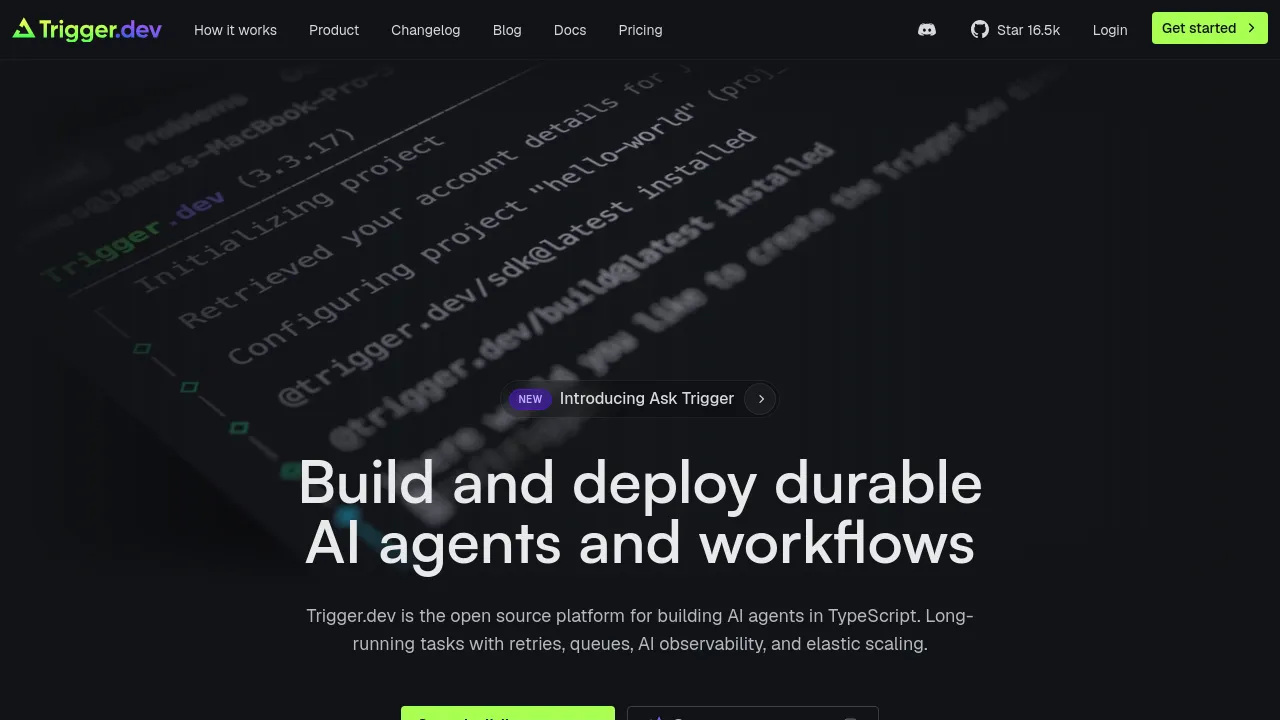
Trigger.dev is an open source platform for building AI agents and background workflows in TypeScript. Tasks run on managed infrastructure that survives refreshes, redeploys, and crashes, so long-running jobs don't die when a serverless function times out. The project is actively developed — recent changelog entries include v4.7.4, a dashboard agent in beta, and auto-archiving for preview branches — and the GitHub repository shows around 16.5k stars.
You write tasks in a Trigger folder in your codebase using regular TypeScript, with typed inputs and outputs. The platform handles the operational side: retries, queues, concurrency limits, cron schedules, and idempotency. For AI work specifically, it supports tool calling, human-in-the-loop approvals (a run pauses and stays alive until someone approves an action), streaming responses directly to your frontend without API routes, and full observability with real-time monitoring and tracing. There's also a chat agent API that wires system prompts, tool approval, compaction, mid-turn steering, and telemetry through a single streamText call, and it works with models like Anthropic's Claude via the Vercel AI SDK.
The docs cover a wide range of use cases: autonomous agents, prompt chaining, routing, parallelization, orchestrators, and evaluator-optimizer patterns, each with example projects. Framework guides exist for Next.js and Node.js, there's an MCP server, and self-hosting is documented for teams that want to run the platform on their own infrastructure. Trigger.dev is available as a hosted cloud product (login at cloud.trigger.dev) with a pricing page, though specific plan details aren't shown on the homepage.
Best for
- Product teams building AI chat agents or autonomous agents in TypeScript that need to survive crashes and redeploys
- Developers offloading long-running async work — media processing, media generation, browser automation, semantic search — that would time out in serverless functions
- Teams that need human-in-the-loop approvals inside automated workflows, such as refund processing or content moderation
- Engineering teams running scheduled tasks and cron jobs with retries and concurrency control
- Anyone who wants AI observability: tracing runs, streaming output, and monitoring agent behavior in real time
- Organizations that prefer open source tooling and want the option to self-host
Frequently asked questions
Is Trigger.dev open source?
Yes. The site describes it as "the open source platform for durable AI agents," and the source code is on GitHub at triggerdotdev/trigger.dev, where it has roughly 16.5k stars.
What languages does it support?
TypeScript is the primary language. The docs also include a guide for running Python within tasks.
Can I self-host Trigger.dev?
Yes. Self-hosting documentation is available in the official docs, alongside the hosted cloud option.
How much does it cost?
There is a pricing page, but the homepage doesn't display plan details or prices, so you'll need to check trigger.dev/pricing for current rates.
Does it work with Next.js?
Yes. There are dedicated framework guides for Next.js and Node.js, and the platform can stream task output directly to your frontend without writing API routes.
What AI agent patterns does it support?
The docs include worked examples for autonomous agents, prompt chaining, routing, parallelization, orchestrators, and evaluator-optimizer loops.
Alternatives
- Pipedream — a better fit if you mainly want to connect existing APIs together with code-level control rather than build custom AI agents in your own codebase.
- SharpAPI — worth considering if you need a ready-made AI-powered API for e-commerce, marketing, or HR tasks instead of writing your own task code.
- Folderr — suits non-developers who want to assemble chat assistants and workflow automations from a platform UI rather than writing TypeScript.

Similar to Trigger.dev
New tools, once a week.
One weekly email with curated tools and founder insights. Unsubscribe anytime. Check our privacy policy.