Tools / Supabase
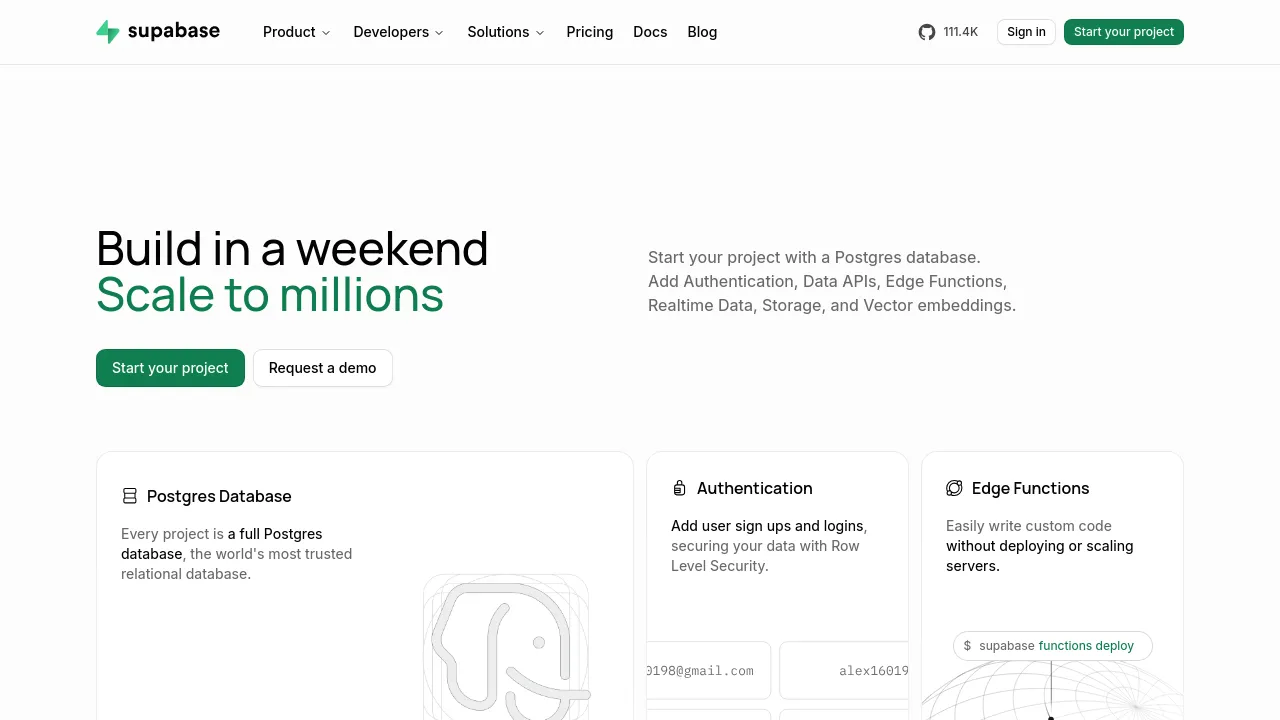
About Supabase
Supabase gives every project a full Postgres database and layers commonly needed backend services on top of it: authentication with Row Level Security, auto-generated REST APIs, Edge Functions, file storage, realtime data sync, and vector embedding support for AI workloads. You can use one product or all of them, and manage everything from a dashboard with a table editor, SQL editor, and RLS policy tools. It's open source (the GitHub repo shows over 111K stars) and the database is portable, so you're not locked into a proprietary data format. Client libraries exist for frameworks like React and Flutter, and the site offers starter templates including a Stripe subscriptions kit, a Next.js app with cookie-based auth, an AI chatbot template, and a LangChain starter.
What Supabase does
Every Supabase project is a real Postgres database — not a stripped-down or proprietary variant. On top of that database, the platform provides:
- Postgres Database — full relational database, 100% portable, with auth built in via Row Level Security
- Authentication — user sign-ups and logins, secured with RLS policies
- Edge Functions — custom server-side code without deploying or scaling servers yourself
- Storage — store, organize, and serve large files like videos and images
- Realtime — data synchronization for multiplayer and live-update experiences
- Vector — store, index, and search vector embeddings, with integrations for OpenAI and Hugging Face models
- Data APIs — instant, ready-to-use REST APIs generated from your database schema
The dashboard includes a table editor, SQL editor, and tools for managing RLS policies, so day-to-day database work can happen without leaving the browser.
Getting started
Supabase publishes quickstarts for frameworks like React, plus production-ready templates on GitHub: a Stripe Subscriptions starter for SaaS apps (built with Stripe, Supabase, and Vercel), a Next.js App Router starter with cookie-based auth, an open-source AI chatbot template using the Vercel AI SDK and OpenAI, a LangChain + Next.js starter, a Flutter user management example, and an Expo React Native starter with auth on web and mobile.
A typical client integration is a few lines — create a client with your project URL and anon key, then query tables directly from the frontend.
Who uses it
The site lists customer stories from companies including Lovable (which uses Supabase as the backend for AI-generated apps), eXp Realty, Phoenix Energy, Chatbase, and Rally.
Pricing
Pricing details are on the pricing page; the homepage itself doesn't list plan specifics.
Alternatives
- Railway — deploy web apps, databases, and services with automatic scaling
- Render — cloud platform for deploying web services, databases, and cron
- Fly.io — run full-stack apps and AI agents close to your users
- Vercel — deploy web applications and AI agents with global delivery
Supabase is more focused than these platforms: it centers on the database and backend services rather than general app hosting. If you mainly need a Postgres backend with auth and APIs, it fits; if you need broader infrastructure control, the platforms above may cover more ground.

Similar to Supabase
New tools, once a week.
One weekly email with curated tools and founder insights. Unsubscribe anytime. Check our privacy policy.