Tools / Blynk
About Blynk
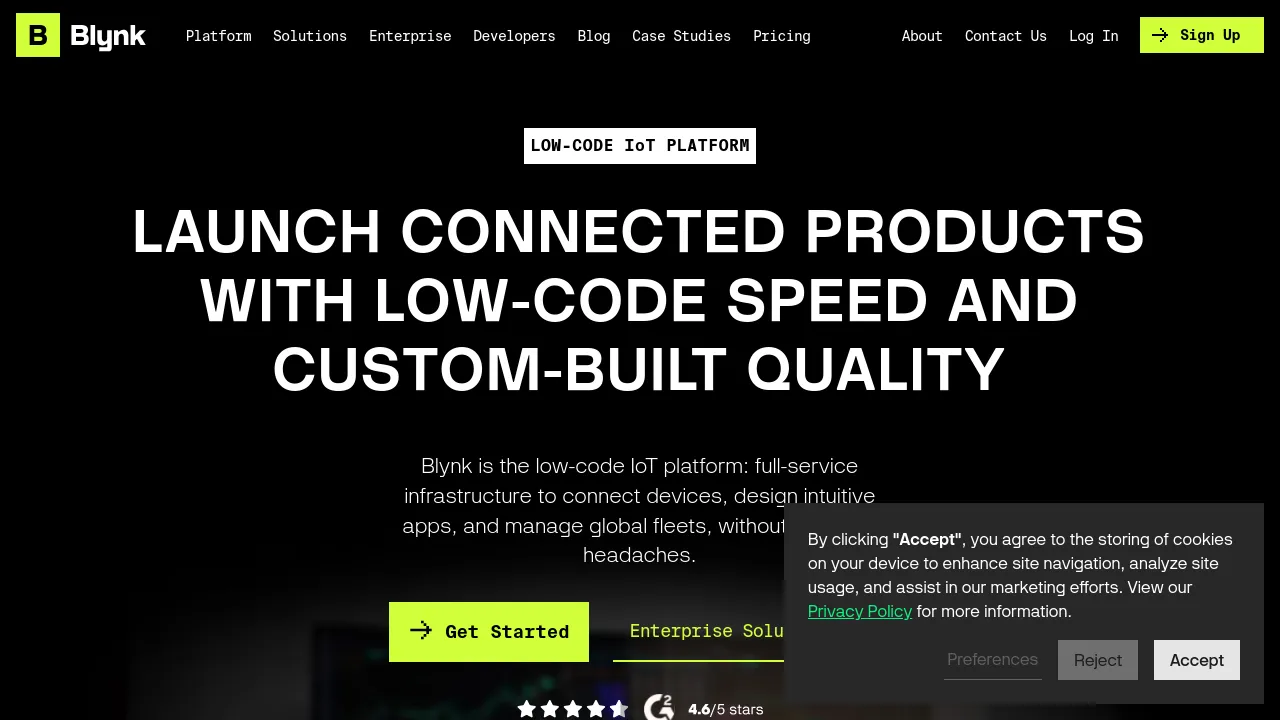
Build branded iOS and Android apps, real-time dashboards, and managed cloud infrastructure for connected devices without heavy coding.
Blynk is a low-code IoT platform for teams building connected hardware products. It covers the software layer of an IoT product — companion mobile apps, web dashboards, device connectivity, and hosted cloud infrastructure — so you don't have to assemble those pieces yourself. Devices connect over MQTT, HTTP, webhooks, and cloud connectors, and the platform handles device provisioning and authentication.
The core feature set includes branded iOS and Android apps you can build and publish, a web console for real-time dashboards and device control, and managed cloud hosting that runs out of the box. Platform services add device provisioning and credential management, a Network Co-Processor (NCP) for adding secure WiFi or cellular connectivity through a dedicated module, a no-code visual editor for automations and event-driven workflows, and user and organization management with teams, roles, permissions, and multi-tenancy.
The site positions the platform across a wide range of industries: energy and HVAC metering, industrial and manufacturing equipment, high-end consumer goods, logistics fleet tracking, agriculture and irrigation, predictive maintenance, smart cities, smart buildings, smart home, and construction. An Enterprise tier is available for larger deployments, and Blynk publishes documentation, a community forum, case studies, and a blog. Recent posts cover a new device provisioning flow in the app, an HTML widget for building dashboards with HTML, CSS, and JavaScript, and AI-powered analytics through the Blynk MCP server.
Best for
- Hardware makers who want branded iOS and Android companion apps without building them from scratch
- Energy and HVAC teams working on smart metering and air monitoring
- Industrial and manufacturing use cases like equipment health monitoring and process automation
- Logistics companies that need fleet tracking and asset visibility
- Agriculture projects covering smart farming and irrigation control
- Organizations that need multi-tenant user, team, and permission management for enterprise deployments
Frequently asked questions
What is Blynk?
It's a low-code IoT platform that combines mobile apps, a web console for real-time dashboards, device connectivity via MQTT, HTTP, and webhooks, and managed cloud hosting for connected products.
How much does Blynk cost?
The site has a pricing page and offers a free sign-up, but the homepage doesn't list plan prices. Check blynk.io/pricing for current tiers.
What hardware and protocols does it support?
Devices connect via MQTT, HTTP, webhooks, and cloud connectors. Blynk also publishes a featured hardware list and offers a Network Co-Processor module for adding secure WiFi or cellular connectivity to existing hardware.
Can I publish my own branded app?
Yes. The platform lets you build and publish branded iOS and Android apps for your connected products.
Is there an enterprise option?
Yes. Blynk Enterprise adds user and organization management with teams, roles, permissions, and multi-tenancy; the site directs enterprise buyers to a contact sales page.
Do I need to write code for automations?
No. Automations and event-driven workflows are defined in a no-code visual editor, though the platform also supports custom dashboard widgets built with HTML, CSS, and JavaScript.
Alternatives
Blynk is an IoT platform, and the alternatives below are general productivity tools rather than direct competitors — they fit when the need is workspace or AI assistance rather than device connectivity.
- Notion — a general workspace for docs, wikis, and projects; useful for a hardware team's internal documentation, not for controlling devices.
- Triplo AI — an AI assistant for day-to-day productivity across apps; pick it if you want AI help rather than IoT infrastructure.
- Jot — docs, spreadsheets, and chat in one workspace; a fit for team collaboration, not connected products.
Similar to Blynk
New tools, once a week.
One weekly email with curated tools and founder insights. Unsubscribe anytime. Check our privacy policy.