Tools / Warp
About Warp
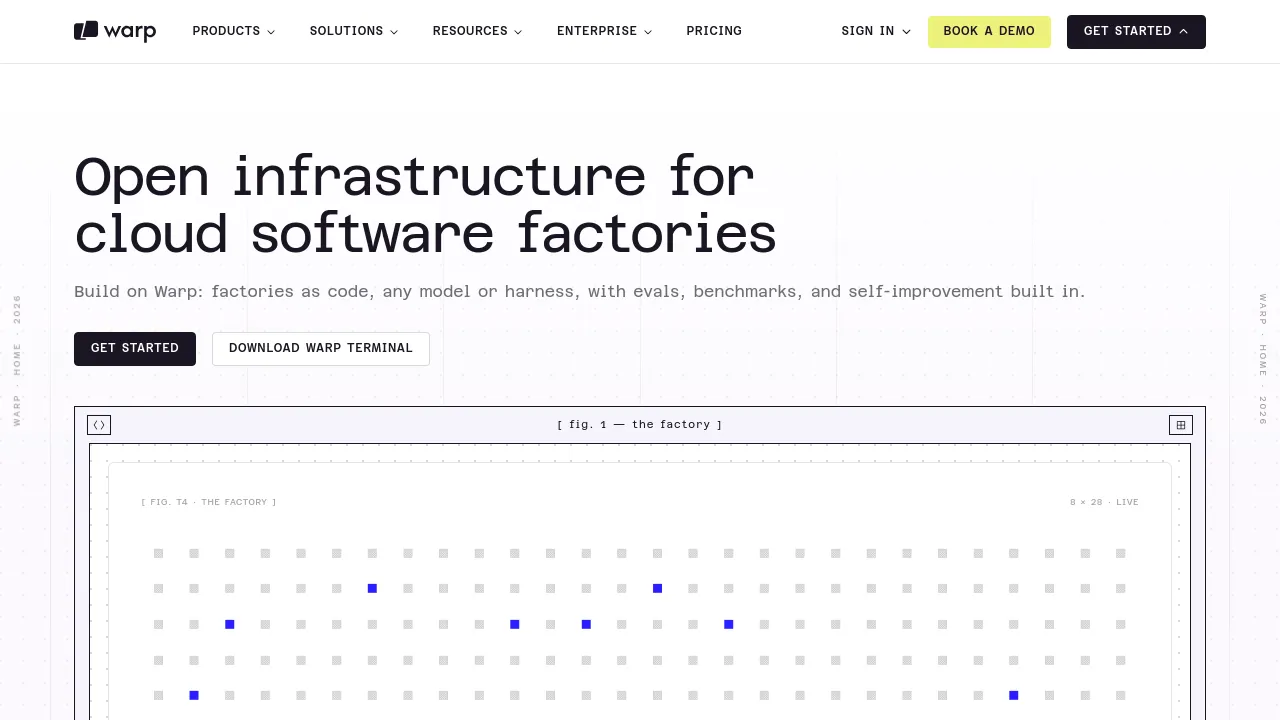
Define software factories in YAML to run AI coding agents across repos, with evals, benchmarks, self-improvement loops, and self-hosting options.
Warp is an agentic development platform best known for its terminal, which it now extends with Warp Factories, a product for running AI coding agents at scale. Teams define a software factory in a factory.yaml file that connects repositories, credentials, MCP servers, and cloud accounts, then sets the models, runners, and defaults that agents inherit. Warp positions this as moving beyond CI/CD to automating the whole software development lifecycle.
A factory definition specifies which repos agents can work in, which secrets they can use (encrypted at rest, injected only during runs), and which cloud roles they can assume — AWS via role ARN or GCP identity, avoiding long-lived keys. Integrations route work in from Slack, Linear, or Jira, and a Foreman handles @-mentions so teammates can assign tasks to a factory by name. Runs ship pull requests, and agents capture screenshots or video through computer use so humans can verify work before merging.
Measurement is built in. Evals score runs against your own work, benchmarks compare models on your tasks, and self-improvement loops have observer agents open PRs against your factory config. Warp published a case study describing how it cut its own cost per PR from $80 to $30 using these benchmarks, and its control plane tracks cost per PR split by compute, platform, and inference.
The platform is open at each layer: any MCP-capable coding agent (the site names Claude Code, Codex, and Cursor), any model whether frontier or open-weight, and Warp's cloud or self-hosting in your own VPC, with pluggable and zero-retention data options. Warp claims over 800,000 developers use its products and publishes customer stories from Docker and from Rectangle Health, which built a self-improving AI teammate that writes 54% of its own code.
Best for:
- Engineering teams that want AI agents handling tasks across the SDLC, not just builds and deploys
- Platform teams that prefer agent infrastructure defined, versioned, and reviewed as code
- Organizations comparing models that need benchmarks run on their own engineering tasks
- Companies with security requirements around central permissions, guardrails, and VPC or self-hosted deployment
- Teams whose work lives in Slack, Linear, or Jira and want agents reachable from those tools
- Developers who want a modern terminal with AI and team workflow features
Frequently asked questions
Is Warp just a terminal?
No. Warp started as a terminal and still offers one, but the platform now centers on Factories. You can watch and steer runs from web, mobile, terminal, or IDE.
Do I have to use Warp's own agent or model?
No. The site says Factories work with any MCP-capable coding agent, naming Claude Code, Codex, and Cursor, and any model, frontier or open-weight, chosen per pipeline stage.
Can Warp run in my own infrastructure?
Yes. You can use Warp's cloud or self-host in your own VPC, and data storage is pluggable with zero-retention options, so you keep what your agents produce.
How does Warp measure agent quality?
Evals score runs against your own work, benchmarks compare model configurations, and self-improvement loops have observer agents open PRs against your factory config to catch regressions and tune prompts.
How much does Warp cost?
The homepage doesn't list pricing. It asks for a work email to book a demo, and Factories access currently goes through a request form.
What integrations does Warp support?
The site names Slack and Linear or Jira for work sources and task tracking, plus MCP servers for shared tools such as Sentry. Cloud access works through AWS role assumption or GCP identities.
Alternatives
- Linear — pick it if you want project and issue planning for human teams rather than agent execution of engineering work.
- Posthog — pick it if your goal is product analytics, feature flags, and experiments rather than automating development.
- Notion — pick it if you need a connected workspace for docs and wikis rather than coding-agent infrastructure.

Similar to Warp
New tools, once a week.
One weekly email with curated tools and founder insights. Unsubscribe anytime. Check our privacy policy.