Tools / Saleor
About Saleor
Saleor is an open-source, AI-ready headless ecommerce platform with a GraphQL API, admin dashboard, and optional managed cloud hosting.
Saleor is an open-source e-commerce platform designed for organizations that require complete control over their digital commerce stack. It functions as a headless commerce backend, meaning it provides the robust engine for managing products, orders, and customers, while allowing developers to build completely custom front-end storefront experiences using any framework they choose. The platform exposes a powerful GraphQL API, which allows for highly granular data fetching across various storefront applications and internal services. Furthermore, Saleor includes a comprehensive, extensible administration dashboard right out of the box, providing immediate functionality for Product Information Management (PIM) and Order Management (OMS).
This architecture is built around the principle of composability. Instead of forcing users into a rigid template, Saleor provides 45+ defined mount points within its UI, enabling custom modifications without requiring the user to fork or alter the core codebase. This level of flexibility is critical for large enterprises, such as Lush Cosmetics and Breitling, which operate across numerous markets and require highly tailored customer journeys. The platform is designed to handle complex, distributed systems, utilizing OpenTelemetry for observability and offering a Configurator CLI to manage data synchronization between the API and the local repository, effectively treating commerce configuration as code.
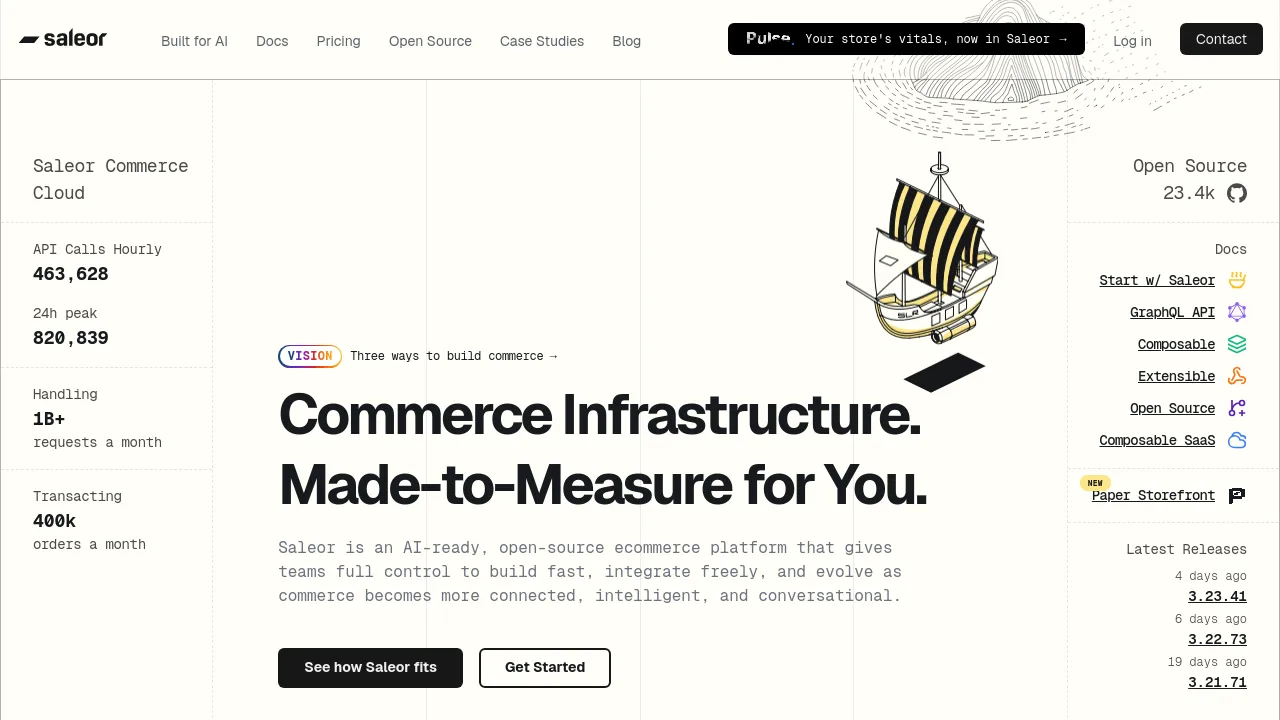
For teams prioritizing technical control and deep integration capabilities, Saleor offers a robust foundation. It is not a simple drag-and-drop solution; rather, it is a powerful framework that requires technical expertise to deploy and maintain. However, for those willing to manage the infrastructure, the platform provides enterprise-grade features, including 160+ webhooks for delegating complex workflows to external services and dynamic data models that adapt to evolving business needs. Whether self-hosting or utilizing Saleor Cloud, the platform supports high-volume operations, with managed services reporting handling hundreds of thousands of API calls hourly and supporting compliance standards like SOC 2 and PCI-DSS.
Best for
- Teams requiring a fully custom, unique storefront design.
- Developers who prefer an API-first, composable architecture.
- Enterprises needing high scalability and complex multi-market support.
- Organizations that want to treat commerce configuration as code.
- Users who require deep integration with existing internal systems.
Frequently asked questions
What does 'headless commerce' mean in the context of Saleor?
Headless commerce means the front-end presentation layer is decoupled from the back-end commerce engine. Saleor provides the data and logic via its API, allowing you to build the user interface using any technology stack you prefer.
Is Saleor suitable for small businesses?
While Saleor is highly capable, it is designed for teams that possess the technical resources to manage a complex, open-source backend. Smaller businesses might find the setup and maintenance requirements challenging.
How does the GraphQL API function within Saleor?
Saleor uses GraphQL to allow clients to request specific data points from the commerce backend. This enables highly efficient data fetching, ensuring the storefront only receives the information it needs, which improves performance.
What are the hosting options for Saleor?
Users can self-host Saleor on their own infrastructure for maximum control, or they can opt for Saleor Cloud, which is the managed hosting solution provided by the core development team.
Alternatives
WooCommerce
WooCommerce is a popular plugin for WordPress that allows users to add e-commerce functionality to their existing WordPress sites. It is generally easier to set up than Saleor but offers less granular control over the core architecture.
PrestaShop
PrestaShop is a traditional e-commerce solution that provides a complete store builder. It is suitable for businesses that want a ready-made solution without needing to build a custom API layer.
SamCart
SamCart is a platform focused on high-converting sales funnels and checkout pages. It is a simpler, hosted solution compared to Saleor, focusing on conversion rather than deep backend customization.
Big Cartel
Big Cartel is a straightforward platform designed for artists and small creators who need a simple way to list and sell physical goods without complex setup.

Similar to Saleor
New tools, once a week.
One weekly email with curated tools and founder insights. Unsubscribe anytime. Check our privacy policy.