Tools / Astro
About Astro
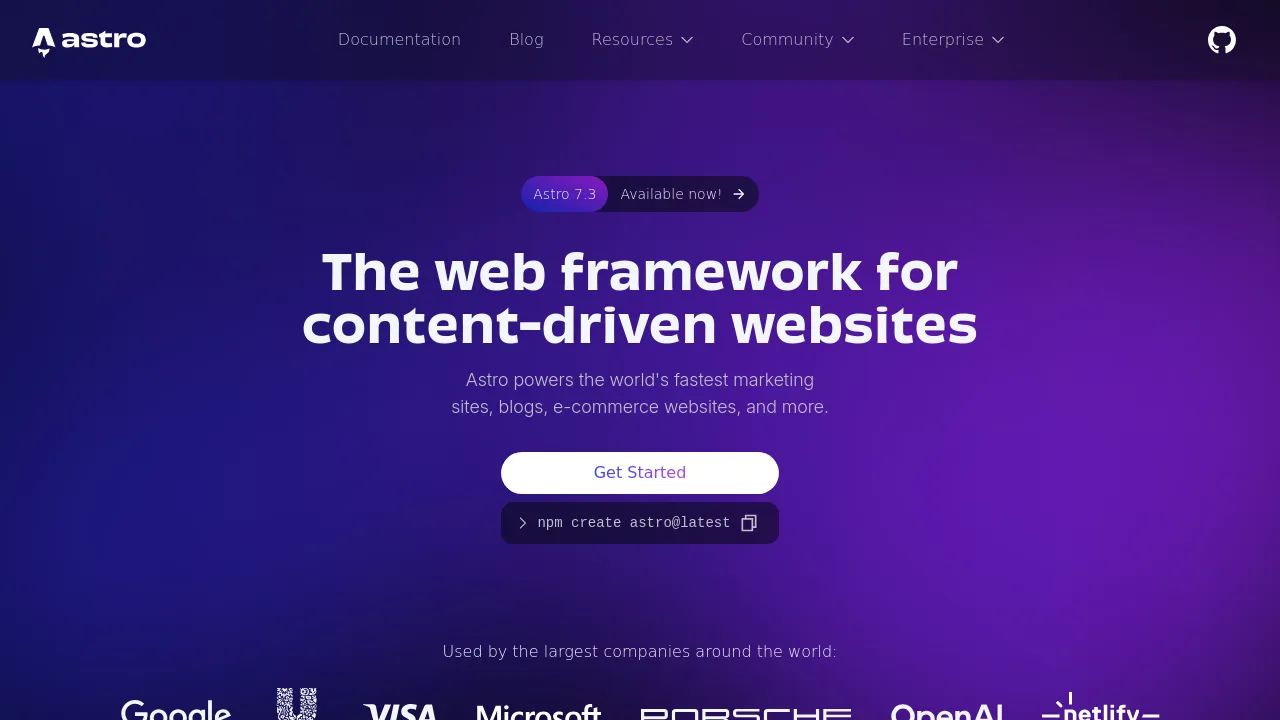
Build content-driven websites with server-first rendering, Astro Islands, and support for React, Vue, Svelte, and more. Free and open source.
Astro is a free, open-source JavaScript web framework built specifically for content-driven websites — marketing sites, blogs, e-commerce stores, and similar projects. Its core idea is "server-first": components render on the server and ship lightweight HTML to the browser, with zero unnecessary JavaScript overhead. When a page does need interactivity, Astro's Islands architecture hydrates only the specific components that require it, leaving the rest of the page as static HTML.
The framework is UI-agnostic. You can write components in React, Vue, Svelte, Angular, Preact, Solid, or Qwik and mix them in the same project, or skip JavaScript frameworks entirely — Astro's own component syntax is close enough to HTML that the homepage claims knowing HTML is enough to write your first component. Content can come from anywhere: the file system, an external API, or a CMS.
Astro ships with a long list of built-in features: Content Collections for organizing Markdown and MDX with TypeScript type-safety and frontmatter validation, browser-native View Transitions, optimized image components, file-based routing, middleware, type-safe backend Actions, automatic prefetching, environment variable management, and a dev toolbar. Deployment adapters provide one-line configuration for Netlify, Vercel, AWS, Cloudflare, Node.js, Deno, and SST. There's also an official MCP server and context files for AI-assisted development.
Performance claims are backed by third-party data: Astro cites HTTP Archive and Chrome UX Report figures showing 71% of real-world Astro sites passing Core Web Vitals, compared to 48% for WordPress, 45% for Gatsby, 35% for Next.js, and 28% for Nuxt.
Beyond the core framework, the ecosystem includes pre-built themes for faster starts and a directory of Astro Partner Agencies for teams that want professional help. The project is funded through sponsors.
Best for
- Marketing sites and landing pages where load speed and Core Web Vitals matter
- Blogs and documentation sites built on Markdown or MDX
- E-commerce sites that pull product data from an API or CMS
- Teams with existing React, Vue, or Svelte components that want to reuse them in a faster site
- Developers migrating from WordPress or Gatsby who want better performance
- Projects that need to pull content from a headless CMS or external API
Frequently asked questions
Is Astro free?
Yes. The homepage states that Astro is free, open-source software supported by sponsors.
Do I have to use a specific UI framework with Astro?
No. Astro supports every major UI framework — React, Vue, Svelte, Angular, Preact, Solid, and Qwik — and you can mix them in one project. You can also build sites with Astro's own HTML-like component syntax alone.
What makes Astro different from Next.js or other frameworks?
Astro is server-first and sends zero unnecessary JavaScript to the browser by default, hydrating only interactive "islands" on a page. It's also designed specifically around content-driven sites rather than highly interactive applications.
Where does Astro deploy?
Astro offers deployment adapters with one-line configuration for Netlify, Vercel, AWS, Cloudflare, Node.js, Deno, and SST, among others.
Can Astro pull content from a CMS?
Yes. Astro is designed to load data from your file system, an external API, or a CMS of your choice.
Does Astro help with AI-assisted development?
Astro provides an official MCP server and context files that integrate with AI tools.
Alternatives
- Prismic — a slice-based headless CMS you can pair with Astro when you want a managed content backend for your marketing site.
- Svelte 5 Starter Kit — a Svelte-based boilerplate if you'd rather start from a full SaaS app scaffold than a content-focused framework.

Similar to Astro
New tools, once a week.
One weekly email with curated tools and founder insights. Unsubscribe anytime. Check our privacy policy.