Tools / Temporal
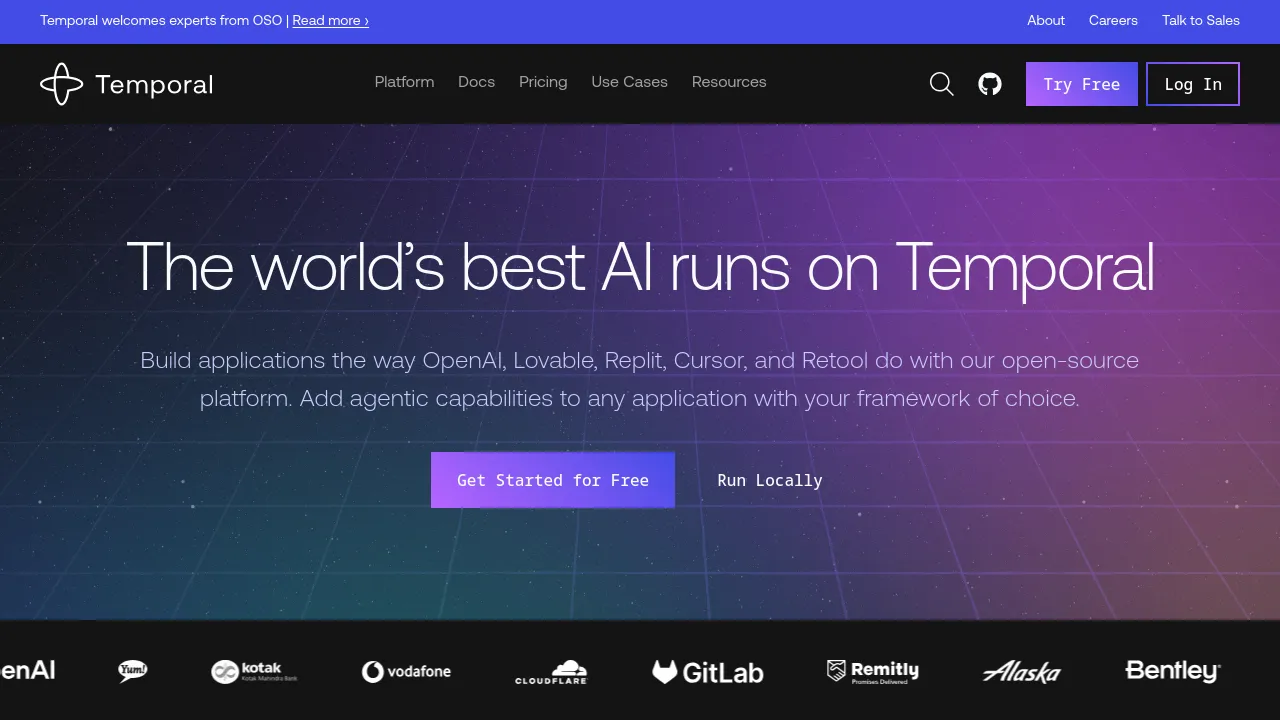
About Temporal
Manages distributed systems failures by automatically capturing state and recovering workflows exactly where they left off.
Distributed systems frequently encounter failures, including API timeouts, network flakiness, and service crashes. Temporal addresses this by providing durable execution, ensuring that complex backend processes do not lose progress when failures occur. Instead of requiring constant manual firefighting or complex reconciliation logic, workflows automatically capture their state at every step, allowing them to resume exactly where they stopped.
Temporal allows engineers to write business logic in familiar programming languages using native SDKs. Workflows handle the overall business process—such as processing an order or deploying infrastructure—while Activities handle the external, failure-prone interactions, like calling a third-party API. The Temporal Service persists the state of these applications, providing built-in retries, task queues, and timers to maintain reliability.
Best for
- Long-running Workflows: Running processes for days, weeks, or months without losing state.
- Order Fulfillment: Ensuring an order moves through the system even if one service fails.
- Saga/Compensating Patterns: Implementing complex transaction logic where failure requires specific rollback actions.
- AI Pipelines: Orchestrating training or data processing pipelines that must survive interruptions.
- Durable Ledgers: Tracking transactions with code that maintains state integrity.
Frequently asked questions
What is Durable Execution?
Durable Execution is the mechanism that captures the full running state of a workflow. If the process fails or is interrupted, it can be recovered and replayed from the exact point of failure.
How does Temporal handle failures?
Workflows are fault-tolerant by default. If an Activity fails (e.g., an API times out), Temporal automatically retries the Activity and ensures the workflow picks up the process again.
Can I host the Temporal Service myself?
Yes. The Temporal Service can be self-hosted as part of the open-source project, or you can use Temporal Cloud for managed hosting.
What is the difference between a Workflow and an Activity?
Workflows define the business logic and manage the overall state. Activities are functions used within the workflow to handle specific, external, and failure-prone tasks, such as network calls.
Alternatives
- Zapier — Use this if you need a powerful automation tool to connect various applications without writing code.
- Make — Consider this if you prefer a visual platform for building and automating tasks and systems.
- Retool — Choose this if your primary need is to quickly build custom internal tools and workflows.
- Integrately — Select this if you need a tool that simplifies workflows using 1-click automations between apps.

Similar to Temporal
New tools, once a week.
One weekly email with curated tools and founder insights. Unsubscribe anytime. Check our privacy policy.