Tools / PagerDuty
About PagerDuty
Orchestrates incident response and automates critical workflows using AI. Provides a single source of truth for system status and manages on-call rotations
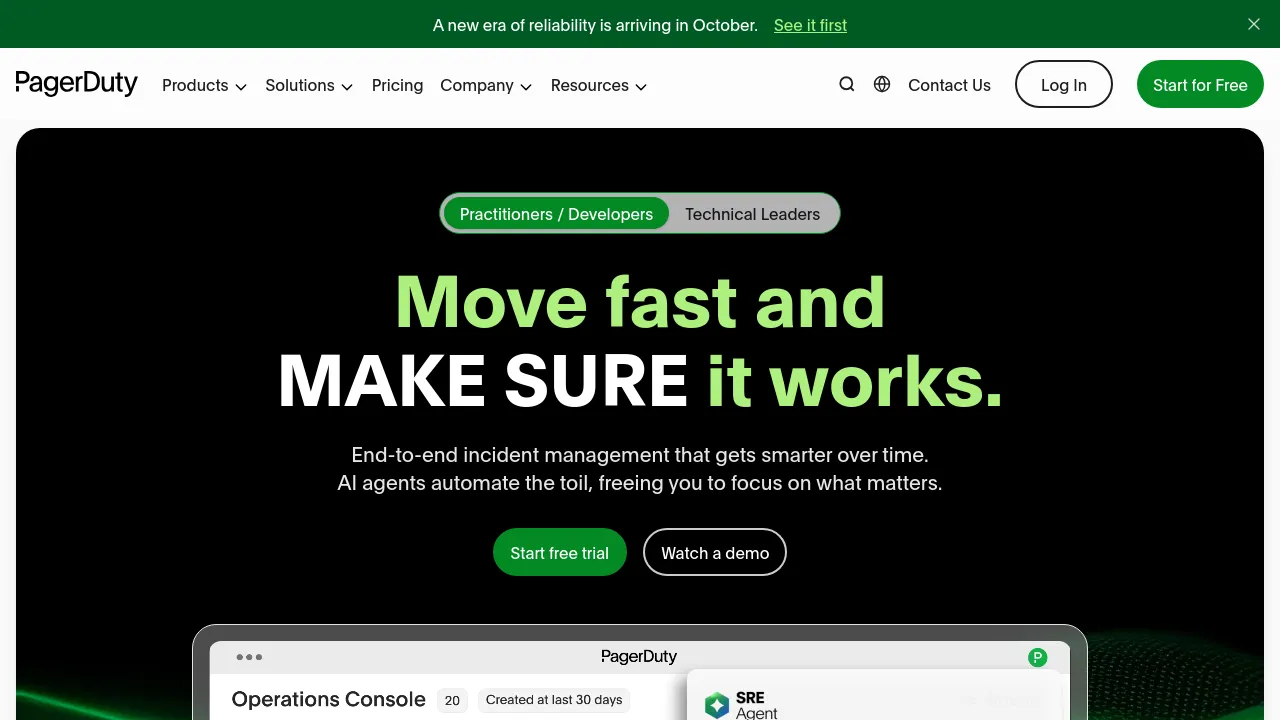
PagerDuty is defined as an AI-First Operations Platform engineered to manage mission-critical workflows within complex, modern enterprise environments. Its primary function is to provide comprehensive, end-to-end orchestration for the lifecycle of operational incidents and system issues. The core objective of the platform is to ensure operational integrity by automating repetitive workflows and significantly reducing the volume of non-actionable alerts through integrated AIOps capabilities. This approach allows technical teams to focus on resolution rather than alert triage.
The foundational component of the platform is the Operations Cloud. This suite encompasses several critical tools, including advanced Incident Management modules, real-time Status Pages for public and internal consumption, and specialized AI Agents designed to automate diagnostic and resolution steps. The architecture is designed for deep connectivity, supporting over 750 integrations with existing enterprise systems. This extensive integration capability allows PagerDuty to function as a centralized operational hub, capable of managing highly complex and distributed IT infrastructures.
Beyond general incident response, PagerDuty offers specialized solutions tailored to specific operational domains. These include Security Incident Management, DataOps, FinOps, and Customer Experience Operations. The platform's applicability spans diverse sectors, including financial services, healthcare, government, and retail, where maintaining high levels of digital resilience and uptime is paramount. The integration of Generative AI and sophisticated AI Agents is a key differentiator, intended to enhance operational efficiency and accelerate the resolution of critical incidents. This suite of tools is primarily directed toward developers and technical leadership responsible for maintaining complex, high-availability systems. Implementation can be managed either through the customizable Developer Platform or through dedicated Professional Services for initial deployment and configuration.
Best for:
- DevOps teams requiring comprehensive, end-to-end incident orchestration across diverse services.
- Engineering managers overseeing complex, multi-tiered on-call rotations and escalation policies.
- Organizations that require a unified, single source of truth for monitoring system health and service status.
- Teams focused on implementing AI-driven alert triage, root cause analysis, and automated remediation workflows.
- Enterprises operating in regulated industries that require robust compliance and security incident management frameworks.
What is the PagerDuty Operations Cloud?
It is the integrated suite of tools and services designed for managing mission-critical operations within an enterprise. The Operations Cloud provides the necessary framework for incident management, automated workflow execution, and centralized status tracking, serving as the operational backbone for complex IT environments.
Does PagerDuty offer AI features?
Yes, the platform incorporates Generative AI and specialized AI Agents. These features are utilized to enhance operational efficiency, automate routine tasks, and reduce alert noise through the application of AIOps methodologies.
How many integrations does PagerDuty support?
According to the platform specifications, PagerDuty supports over 750 integrations, enabling connectivity with a wide variety of enterprise systems and monitoring tools.
What industries use PagerDuty?
PagerDuty is utilized across various sectors, including financial services, healthcare, government, education, and retail, to maintain operational stability and digital resilience.
Alternatives
In the market for incident response and operational management, several platforms offer competing functionalities, depending on the specific organizational needs and existing technology stack. For organizations primarily focused on IT Service Management (ITSM) and comprehensive workflow automation, ServiceNow is a major alternative, offering a broader suite of tools that extends beyond incident response into service delivery and change management. For teams seeking highly specialized monitoring and alerting capabilities, tools like Datadog or Dynatrace are often utilized, providing deep observability into application performance and infrastructure health, though they may lack the centralized incident orchestration focus of PagerDuty.
If the primary requirement is focused on open-source solutions and highly customizable alerting, Prometheus combined with Alertmanager is a common choice for infrastructure monitoring, although it requires significant internal engineering effort to achieve the level of end-to-end orchestration and AI-driven automation offered by commercial platforms. For smaller teams or those needing a simpler, more focused approach to on-call scheduling and basic incident management, dedicated tools like Opsgenie or Jira Service Management may provide sufficient functionality without the full complexity and integration depth of the PagerDuty Operations Cloud.
Similar to PagerDuty
New tools, once a week.
One weekly email with curated tools and founder insights. Unsubscribe anytime. Check our privacy policy.