Tools / Telnyx
Telnyx
Inference, voice, and messaging APIs from a licensed carrier that owns its network, edge compute, and GPUs.
About Telnyx
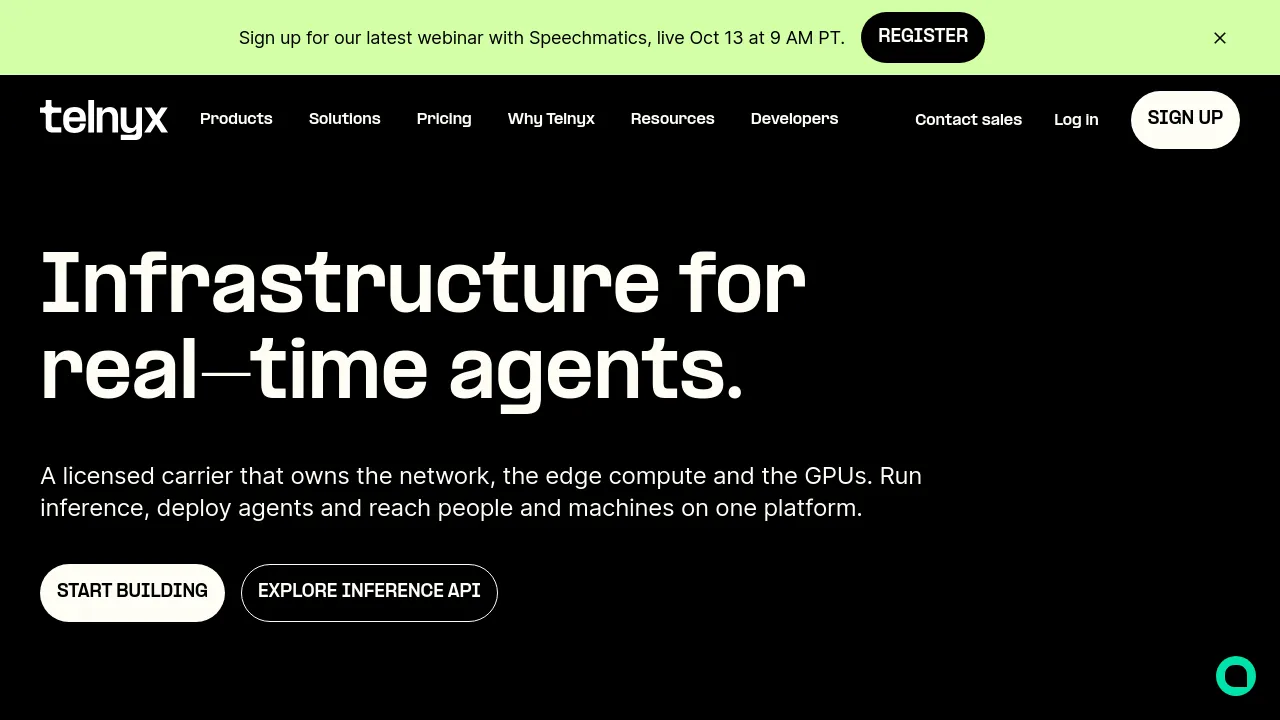
Telnyx is a licensed carrier that operates its own private global backbone, edge compute, and GPUs. Its homepage now leads with "infrastructure for real-time agents": an OpenAI-compatible inference platform for open-weight models, offered alongside the voice, storage, and wireless products on one control plane and one bill. The company is categorized here under communications APIs, and voice and messaging remain part of the product set — but inference is the headline now. The inference API works with your existing OpenAI SDK: you set the Telnyx base URL, API key, and model in your current client. Supported models stream responses, call tools, and return structured outputs. Serverless inference runs open-weight models on demand with usage-based pricing and no long-term commitments; dedicated inference and reserved GPU capacity cover open-source, custom, or fine-tuned models. Hosted models include GLM-5.3 and GLM-5.3-Flash, DeepSeek-V4.1-Flash, Kimi-K3 and Kimi-K2.6, MiniMax-M3-MXFP8, Qwen3.8-27B, Qwen3-Embedding-8B, and Gemma-4-26B-A4B-it. Around inference, Telnyx ships an edge runtime that runs containerized code at its points of presence: Functions for containerized apps, StatefulActor for entities whose state survives restarts, S3-compatible Object Storage, KV with TTLs, SQLDB (serverless SQLite), and CloudFS filesystem mounts. An Agent SDK adds persistent state, memory, scheduled tasks, and bindings to Telnyx's communications APIs. The company counts 50 such primitives on the single control plane. The site lists numbers and voice coverage in 140+ countries, 25+ points of presence on its private backbone, and real-time support for 100+ languages. Telnyx also publishes its own GLM-5.3 latency benchmark — 9.87s median full-response time versus 14.67s (Together), 20.61s (Fireworks), and 21.81s (Baseten) on an ~88.7k-input / 1,200-output-token workload — with the caveat on its own page that the results are specific to that model and test, not an SLA.
What it does
- OpenAI-compatible inference API — keep your existing OpenAI SDK and swap in the Telnyx base URL, API key, and model
- Streaming, tool calling, and structured outputs on supported models
- Serverless inference with usage-based pricing and no long-term commitments
- Dedicated inference and reserved GPU capacity for open-source, custom, or fine-tuned models
- Hosted open-weight models: GLM-5.3, GLM-5.3-Flash, GLM-5.2, DeepSeek-V4.1-Flash, telnyx/decision-pro, Kimi-K3, Kimi-K2.6, MiniMax-M3-MXFP8, Qwen3.8-27B, Qwen3-Embedding-8B, Gemma-4-26B-A4B-it
- Edge runtime at Telnyx PoPs: Functions (containerized apps with your own dependencies) and StatefulActor (persistent per-entity state, one call at a time)
- Storage primitives: S3-compatible Object Storage, KV with TTLs, SQLDB (serverless SQLite), CloudFS filesystem mounts
- Agent SDK with persistent state, memory, scheduled tasks, and bindings to Telnyx communications APIs
- Voice and numbers in 140+ countries, 25+ points of presence on a private backbone, 100+ languages in real time
- 50 primitives on one control plane and one bill — inference, voice, storage, and wireless share the same infrastructure
Pricing
The homepage says serverless inference is usage-based with no long-term commitments, but it doesn't publish specific rates. Pricing for dedicated inference and reserved GPU capacity isn't shown on the homepage either.
FAQ
What is Telnyx? A licensed carrier that owns its private global backbone, edge compute, and GPUs. It sells an OpenAI-compatible inference platform for open-weight models alongside voice, storage, and wireless products, all on one control plane and one bill.
Can I use my existing OpenAI code with it? Yes, per the homepage: set the Telnyx base URL, API key, and model in your existing OpenAI SDK client. Streaming and tool calling are supported.
Which models does it host? GLM-5.3-Flash, GLM-5.3, GLM-5.2, DeepSeek-V4.1-Flash, telnyx/decision-pro, Kimi-K3, Kimi-K2.6, MiniMax-M3-MXFP8, Qwen3.8-27B, Qwen3-Embedding-8B, and Gemma-4-26B-A4B-it. You can also bring open-source, custom, or fine-tuned models to dedicated inference.
How much does it cost? The homepage says serverless inference is usage-based with no long-term commitments, but specific rates aren't published there. Check the site for current pricing.
Is the latency benchmark independent? No — it's Telnyx's own published test. It compares median full-response latency for GLM-5.3 (9.87s) against Together (14.67s), Fireworks (20.61s), and Baseten (21.81s) on one ~88.7k-input / 1,200-output-token workload, published September 18, 2026, based on 6–10 answered requests per provider. Telnyx's page notes the results are specific to that model and test, not an SLA.
Does Telnyx still do voice and messaging? Voice, yes — the homepage cites numbers and voice coverage in 140+ countries and names voice as one of its starting products. The current homepage doesn't go into SMS specifics, but Telnyx is categorized under communications APIs and its Agent SDK binds to its communications APIs.
Alternatives
- Twilio — The API for SMS, voice, email, and verification. The incumbent most communications-API buyers compare against.
- Bandwidth — Carrier-owned communications APIs. The closest structural match to Telnyx's owned-network model.
- Plivo — SMS and voice APIs with predictable pricing.
- Vonage — Communications APIs covering SMS, voice, and video.
Similar to Telnyx
New tools, once a week.
One weekly email with curated tools and founder insights. Unsubscribe anytime. Check our privacy policy.