Tools / Medusa
About Medusa
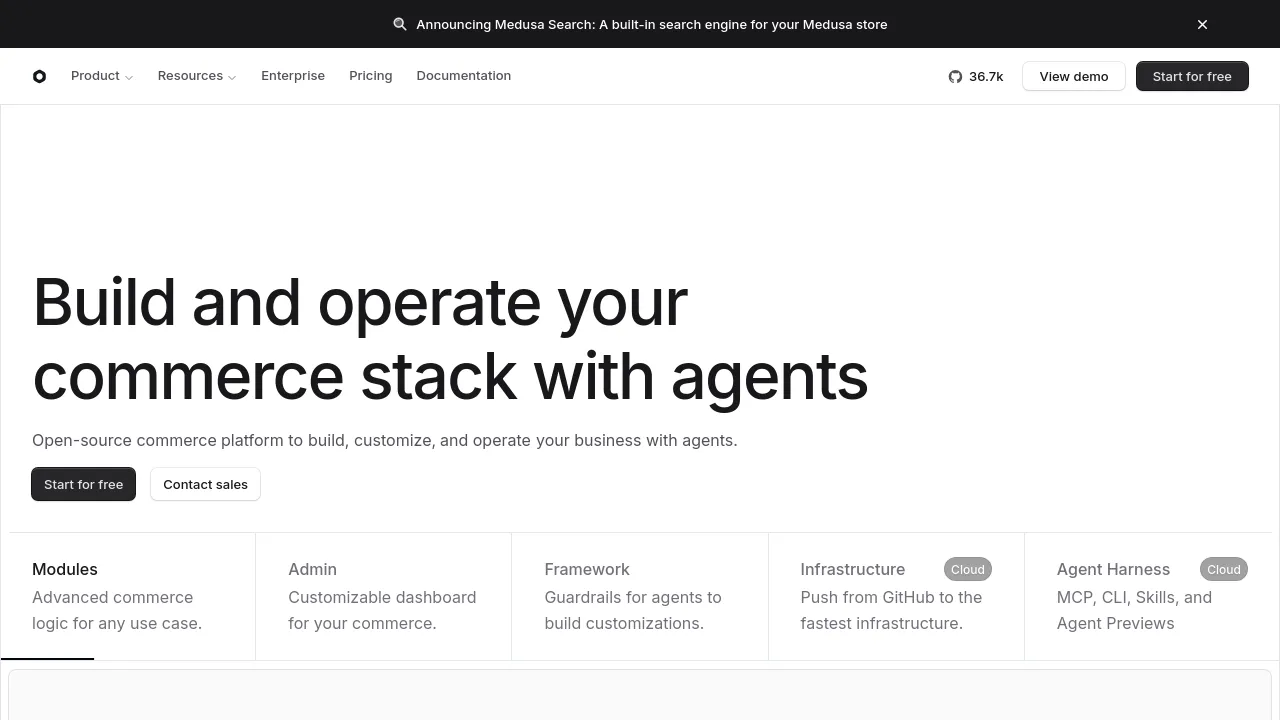
Medusa is an open-source commerce platform with modular commerce logic, a customizable admin dashboard, and optional cloud hosting. Free to self-host.
Medusa is an open-source commerce platform designed for developers who require granular control over their e-commerce backend. It functions as a complete commerce stack, allowing users to build and manage complex sales operations from the ground up. The platform is built around modular components, ensuring that the core logic—such as product management, order processing, and cart functionality—can be customized for various business models, including B2C, B2B, and multi-vendor marketplaces. This modular approach means that developers are not constrained by a single, predefined structure, but rather build the specific architecture needed for their unique business requirements.
A key differentiator for Medusa is its focus on 'agentic commerce.' This means the platform is not just a standard storefront builder; it includes specific tooling for integration with AI agents. Components like the MCP server, specialized agent skills, and agent preview capabilities are built directly into the product. This architecture allows developers to build commerce workflows that interact intelligently with automated systems, moving beyond traditional static e-commerce setups and enabling advanced, automated business processes.
The Medusa ecosystem is composed of several distinct parts: core Modules handling commerce logic, a customizable Admin dashboard, a Framework for building customizations, and the Cloud service for managed hosting. Users have the option to self-host the entire system using the open-source code available on GitHub, which provides complete ownership of the data and infrastructure. Alternatively, Medusa Cloud offers a managed experience that includes autoscaling, caching, and automated deployment, making it suitable for teams that want the benefits of Medusa without managing the underlying infrastructure.
Best for:
- Teams needing complete backend ownership and control over their commerce data.
- Developers building complex, custom AI-driven commerce workflows.
- Businesses operating across multiple sales channels (B2C, B2B, Marketplaces).
- Organizations migrating from proprietary platforms like Shopify who need a flexible, open-source alternative.
- Projects requiring deep integration with custom business logic and third-party systems.
Frequently asked questions
Is Medusa free to use?
The core software is open source and free to self-host. Medusa Cloud offers a free tier to begin development, but enterprise features like Role-Based Access Control (RBAC) require a paid plan.
How do I start using Medusa?
New users can begin by reviewing the quickstart documentation, exploring available starters, or testing the hosted demo of the Admin dashboard and Medusa Cloud.
What kind of businesses use Medusa?
Medusa has been adopted by large and complex entities, including Heineken, Eight Sleep, and Mitsubishi Motors, across diverse sectors like B2C, B2B, and large-scale distribution.
Does Medusa handle payments and fulfillment?
The core Modules manage order processing and fulfillment logic. Integration with third-party payment gateways is required, as is standard for most e-commerce platforms.
Alternatives
- Gumroad (slug: gumroad)
- SamCart (slug: samcart)
- ThriveCart (slug: thrivecart)
- WooCommerce (slug: woocommerce)

Similar to Medusa
New tools, once a week.
One weekly email with curated tools and founder insights. Unsubscribe anytime. Check our privacy policy.